

Becoming a Reparations Congregation: Tabernacle United Church
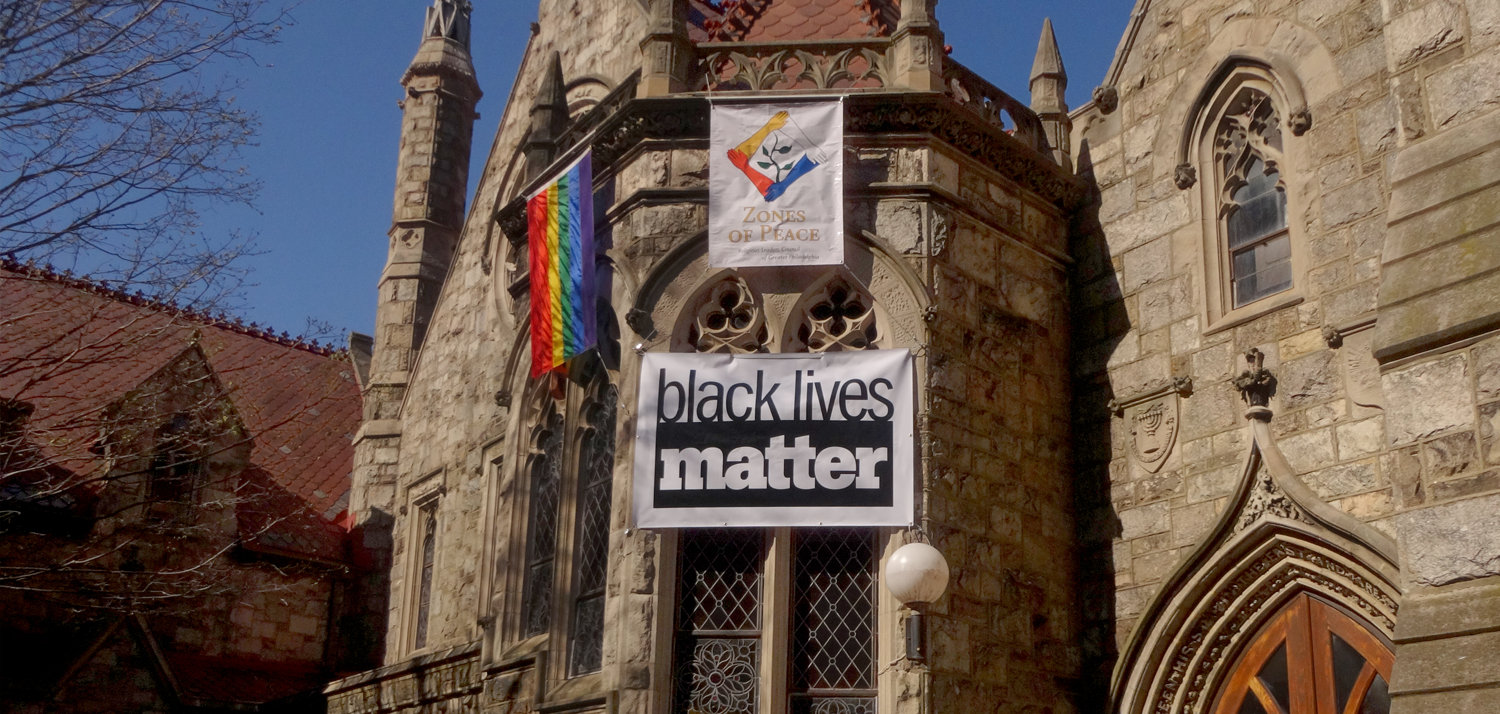
Tabernacle United Church in West Philly
“Our building is being sold and we want to make sure that reparations is part of our moving forward.” Verona Stern
a blog post by Jim Christopher
A CHURCH LED BY AND FOR THE MARGINALIZED
Tabernacle United Church (Abbrev: TAB United) seeks to extend the love and acceptance God offers us to the community around them and believe in centering the prophetic voices of marginalized communities. TAB is an eclectic congregation led by queer and transgender staff and welcomes all people, including those who have been previously excluded elsewhere.
A FASCINATING MIXED HISTORY
TAB United traces its history back to 1873 when Seventh Presbyterian merged with Sixth Presbyterian to form “Tabernacle Presbyterian Church” , eventually relocating to West Philadelphia where their current church property was built in 1884. Over time the church grew its affiliation with the University of Pennsylvania while growing in its commitment to the powerful and controversial Social Gospel movement that applied Christian ethics to social problems, especially issues of social justice such as economic inequality, poverty, alcoholism, crime, racial tensions, unequal education and the anti-war movement.
In the 1960’s and 1970’s Tabernacle’s battle for social justice included a fight to save the homes of Black families in the surrounding neighborhood but the cruel hand of redevelopment eventually destroyed all of the longtime residences around the church. The church continued to seed and nurture non-profit organizations including Action Alliance of Senior Citizens, Women in Transition, The Gray Panthers, and Women’s Alliance for Job Equity. Commitment to the struggles of the working poor, the marginalized and the disenfranchised remain at the core of TAB United’s mission and it fuels their current journey toward Reparations and the community engagement and relationship building that brings.
Rev. Katie Aikins, TAB’s pastor since 2012, described her initial introduction to reparationWorks and how that impacted her and her congregation:
“I was immediately moved by the invitation to the reparations course that was offered in 2023 and had wanted to learn more. I felt like it could be a good next step for us that would deepen our work for racial justice. And then, when I took the class with others, it was transformative.”
Katie is emphatic regarding the part faith plays in their commitment to reparations and restorative justice:
“It's all about faith because reparations is, in a deep way, about our ability to repent and to be people who are willing to face harms that we've done and look at ways to repair. And to me, that is the absolute heart of the gospel.”
Verona Stern, an African-American longtime member of TAB United and part of the Church’s internal Reparations Committee put it this way:
“We're babies in this work of reparations, so when we saw the workshop we thought that it was a good opportunity for us to gain more knowledge and to connect with other church communities that are doing this work.”
Her passion for the mission is balanced by her recognition of the challenge involved.
“Reparations is a part of our mission. It's one of the topics that's really important to us, and it's not just a topic, we want to not only say that we're for reparations, but to show actions that we are supportive of reparations.”
A DECISIVE MOMENT IN THEIR HISTORY
TAB is in a potentially powerful, not unique, position because they are in the process of selling their longtime church property and will be looking at major changes in their relationship with the surrounding community. It’s a liminal space in which their choices and actions can have a major impact on the neighborhood and their church’s legacy. Rev. Katie reflected on this:
“Immediately there's a lot on the table around the sale of the building. So committing to reparations being a part of that process and the discernment during that process, particularly around the proceeds of when we sell, that's a biggie.”
Verona was even more direct in her recognition of the moment’s significance.
“Our building is being sold and we want to make sure that reparations is part of our moving forward.”
The education and mentoring they’ve received from reparationWorks has allowed Rev Katie and Verona and other members to engage more fully with their primarily white congregation and to go deeper in those conversations with a sense of clarity and informed conviction.
“I've been pleasantly surprised at people's openness and willingness to really look at this,” says Rev. Katie. “I think I had some assumptions that we would kind of clamp down and not be open, but that was not the case.”
Regarding her fellow congregants, Verona was clearly pragmatic:
“Some of the conversations about reparations will not be easy for the white members of our congregation, especially, but I feel that TAB is committed to reparations and is willing to do the hard work to make reparations come forth.”
Both leaders were adamant about the impact of reparationWorks on their personal and spiritual alignment to this work and mission at the current time:
“I'm learning that there's something about the time that we're in right now. It just feels like things are being opened up in a good way,” says Rev. Katie. “Some of the collapse of systems... learning what hasn't worked and what's not working. There's a kind of openness and even joy in exploring and confronting hard stuff.”
Verona Stern put it plainly, expressing how much reparationWorks turned the key for her.
“Going to the workshop at Pendle Hill has been very transforming, because it allowed me to see that there are other people and other congregations like ours that are committed to this work, who feel that this work is important, and feel like this is what God is asking us to do.”